View source
https://openlibrary.org/works/OL16239379WBook review
The Better Angels of Our Nature Review
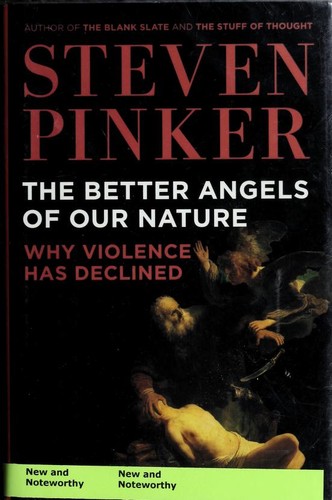
This The Better Angels of Our Nature review offers a professional critical guide to The Better Angels of Our Nature, with reader-fit context, strengths, cautions, and related reading.
- Author
- Steven Pinker
- First published
- 2011
The Better Angels of Our Nature review: progress claims under scrutiny
The The Better Angels of Our Nature opens with a major intellectual tension. Pinker argues that modern violence has declined across many long-run indicators, while daily experience often feels more conflictual. The review sees this tension as productive rather than contradictory, because public memory often amplifies immediate threat while long-horizon trends require different evidence standards.
This is where the book belongs in history and ideas as a social-scale interpretation. It is useful not for sentimental reassurance, but for testing the scale at which claims about morality and institutions are made.
The Better Angels of Our Nature: strengths of the argument
The strongest point is the sustained effort to connect governance, rights, and social learning to reduced violence in many contexts. For readers exploring policy history, this is one of the review's biggest assets.
Pinker also creates a comparative challenge by inviting readers to evaluate claims across time and method. This is useful for students and policy readers who move between evidence and interpretation.
For methodological counterpoint, this review recommends pairing with The Righteous Mind review to compare moral mechanism with long-run trend arguments.
The Better Angels of Our Nature: limits and reading discipline
The key caution is data comparability. Different periods, categories, and reporting systems require careful interpretation. Without that care, the model can appear more certain than it is.
Another limit is experiential mismatch. Long-run trends can be informative, yet communities may still face concentrated violence or structural harm. The review emphasizes this distinction as central to policy interpretation.
There is also a narrative risk when optimistic framing is detached from local evidence. Some readers may use trend claims as absolution. That is not the intended use, but it is a practical misuse the review flags.
The Better Angels of Our Nature: reader fit and route
This book is suitable for readers who want a macro moral frame and who are willing to verify methodology. It is less suitable as a first stop for readers expecting a short polemical argument.
The practical route:
- Start with this review for trend framing.
- Compare with The Dawn of Everything review for social variation.
- Add The Structure of Scientific Revolutions review for how evidence regimes change.
For civic readers, this route sits well with best books for curious readers and keeps debate anchored.
The Better Angels of Our Nature: operational use
Use the book as a benchmark, not an ending claim. The strongest reading method is to pick one policy area and evaluate whether historical trend claims and lived social reality diverge in ways that matter locally.
In team settings, this avoids both romantic optimism and chronic pessimism. The framework then supports more grounded discussion.
The Better Angels of Our Nature: final assessment
This review concludes the book is one of the stronger modern attempts to link data and ethics at civilizational scale. Its quality depends on how readers handle method and caution.
Read it if you need long-run context for modern moral debates, and pair it with context-specific studies before deriving policy conclusions.
Data, violence, and moral interpretation
The review extends the book into a civic method for readers who need long-horizon perspective without romanticizing outcomes. The Better Angels of Our Nature is useful when it becomes a baseline for careful skepticism.
At the personal level, the strongest test is whether readers can distinguish trend interpretation from policy prescription. A trend number can improve understanding, but only if a reader separately defines what kinds of harm are comparable across time.
At the social level, this review recommends one practical rhythm: map one argument from the book against one local data source and one lived narrative. That triad catches the gap between headline claims, lived reality, and methodological detail.
At the editorial level, teams can use this model as a correction mechanism against both naive pessimism and naive optimism. A strong moral framework should not flatten uncertainty or dismiss lived trauma.
For comparative sequence, pair this with The Righteous Mind review for conflict language and with The Structure of Scientific Revolutions review for methodological limits. This creates a chain from social theory to evidence critique.
If this review is used in policy or education settings, follow with The Immortal Life of Henrietta Lacks review and The Sixth Extinction review to compare how systems convert moral claims into governance design.
The practical close is this: use the book as a provocation to improve your moral reasoning standards, not as a universal ending claim.
Policy reading and long-horizon caution
This review treats The Better Angels of Our Nature as a bridge between moral argument and institutional design. If it is read only as reassurance, it fails its own standards. If it is read as a method question, it becomes a productive starting point for governance and education.
The practical method is to set two timelines for each major claim. The first timeline should cover civilizational indicators. The second should cover immediate communities where risk is concentrated. Most confusion in public debate comes from switching between these scales without naming the shift.
In history and ideas, this review finds value in pairing the book with The Righteous Mind review because moral intuition and trend reasoning often talk past each other. The pairing helps readers test when language of cooperation is backed by institutional design.
For reader transfer, build one note format:
- claim,
- evidence boundary,
- social scale,
- policy implication that changes behavior.
When this format is used, the book's value rises because readers move from emotional reaction to accountable comparison. That move is especially useful for civic educators and teams that discuss risk communication.
This review recommends sequencing with The Structure of Scientific Revolutions review for epistemic method and The Dawn of Everything review for social alternatives. The sequence prevents both simplistic optimism and deterministic pessimism.
The practical closing check is simple. If reading this title changes how a reader frames one policy debate about violence, fairness, or trust, then the review considers it operationally successful.
Long-horizon claims and short-horizon responsibility
The review now extends The Better Angels of Our Nature into a practical civic routine. The strongest use is when readers move from one moral conclusion to one accountability design. Long narratives without clear responsibility become abstract.
At team level, this review recommends a short operating sequence. For one claim about social progress, name one affected population, one measurable indicator, and one governing decision that could improve outcomes. Repeat after one quarter.
In history and ideas, pair this review with The Righteous Mind review to prevent disagreement from turning into tone management. This prevents overconfidence from both pessimistic and optimistic narratives.
For policy or civic roles, the review suggests one practical route:
- identify one claim,
- identify one nearby data source,
- identify one policy route that can reduce harm if the claim is accurate.
That method is not neutral. It asks for decisions. The review is successful when it supports better decisions, not only richer debate.
Decision-ready ethics after the long arc
A practical extension from this review is to apply one claim from the book as a policy comparison test before discussing new initiatives. Pick one claim, identify two assumptions behind it, and specify what evidence would change the conclusion in practice. This prevents moral language from becoming a substitute for process.
For readers who work in civic communication, this method can prevent performative clarity. The strongest application is in mixed audiences: one person-level interpretation and one institution-level implication should always be produced before advocacy moves. That prevents the review from becoming only narrative and keeps it accountable.
For comparative depth, pair this review with The Righteous Mind review and The Immortal Life of Henrietta Lacks review. The trio is useful when moral claims and procedural fairness are both under pressure.


